
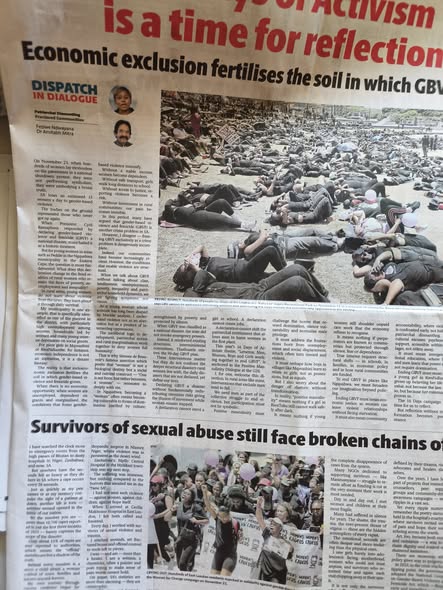
Amitabh Mitra Daily Dispatch 4th of December 2025
I have watched the clock move in emergency rooms from the high passes of Bhutan to dusty hospitals in Niger, Zimbabwe, and now, SA.
But nowhere have the seconds felt as heavy as they do here in SA where a rape occurs every 26 seconds.
Just as quickly as my pen moves or as my memory conjures the sight of a patient at dawn, another life is torn — another wound opened in the fabric of our nation.
Yet the number you see — more than 10,700 rapes reported in just the first three months of 2025 — barely captures the scope of the disaster.
Only about 15% of rapes are ever reported to authorities, which means the “official” statistics are but a shadow of the truth.
Behind every number is a story: a child afraid, a woman robbed of voice, families and futures scarred forever.
My own journey through trauma medicine began far from SA — in the ice-clad hospitals of the Kingdom of Bhutan.
There, I learnt resilience under the weight of mountains and in the isolation of high-altitude clinics.
Later, I served as a UN orthopaedic surgeon in Niamey, Niger, where violence was as persistent as the desert wind.
Zimbabwe’s Mpilo Central Hospital in the Mzilikazi township was my next stop.
The suffering was immense, but nothing compared to the horrors that awaited me in the “New SA”.
I had not seen such violence — against women, against children, against hope itself.
When I arrived at Cecilia Makiwane Hospital in East London, I felt both called and haunted.
Every day, I worked with survivors of sexual violence and trauma.
I stitched wounds, set fractured bones and offered counsel to souls left in pieces.
I was — and am — more than a healer. I am a witness, a chronicler, often a painter and poet trying to make sense of pain words cannot hold.
On paper, SA’S statistics are more than alarming — they are catastrophic.
In 2025, rape and femicide reached such a peak that the government declared genderbased violence (GBV) a national disaster.
On average, 48 children are raped each day, and, over the last six years, more than 106,000 cases of child rape have been officially reported.
But the real toll is much higher — systemic underreporting, shame and fear shroud the actual scale.
UN Women estimates that a South African woman is killed every three hours, and women here face a risk of murder five times higher than the global average.
Most cases of violence I have treated were not random attacks, but intimate partner violence — a betrayal within the supposed safety of home.
Yet for all these statistics, conviction remains a mirage. Only 8.6% of reported rape cases lead to a guilty verdict.
Survivors still face broken chains of justice: lost evidence, delayed trials and, sometimes, the complete disappearance of cases from the system.
Many NGOS dedicated to supporting survivors — like Masimanyane — struggle to remain afloat as funding is cut at the very moment their work is most needed.
Day in and day out, I met women and children at their most fragile.
Many had suffered in silence for years. The shame, the trauma, the ever-present threat of stigma — these are the hidden accomplices of every rapist.
The emotional wounds are often deeper and more enduring than the physical ones.
I saw girls barely into adolescence facing motherhood, women who could not trust anyone, and survivors who returned time and again, each visit chipping away at their spirit.
It is not only the survivors who suffer. Every rape is an assault on a nation’s soul — a message that no one is safe, that justice is out of reach.
The cost is counted not just in broken bodies but in lost futures, fractured families and communities living in quiet, persistent fear.
Despite the darkness, I have seen extraordinary resilience.
Many survivors, refusing to be defined by their trauma, rise as advocates and healers themselves.
Over the years, I have been part of projects that trained lay counsellors, peer support groups and community-driven awareness campaigns — small ripples in a vast sea.
Yet every ripple matters. I remember the poetry slams we held in the hospital’s courtyard, where survivors recited verses of pain and hope, their voices echoing across the wards.
Art, too, became both escape and resistance — a way to reclaim dignity and control over shattered narratives.
There are moments when policy gives way to progress.
In 2025, as the crisis reached a tipping point, the government adopted the National Council on Gender-based Violence and Femicide Act, which —though early and imperfect — is a step toward co-ordinated, multisectoral action.
Still, laws alone cannot transform reality without the help of an informed, compassionate and fiercely persistent civil society.
South Africa’s rape crisis is not a purely local challenge. It is a warning to the world — a signal of what happens when silence, stigma, poverty and injustice combine.
No country is immune. But there is hope. Every survivor who speaks, every healer who listens, every advocate who fights for justice — these are the architects of possibility.
From the makeshift clinics of Bhutan and Niger to the busy emergency rooms of East London, my work as a trauma surgeon, artist and poet has taught me this: Medicine, at its best, is more than science. It is memory, empathy, and imagination.
We are called — not just as doctors or South Africans or activists — but as human beings to break the silence, honour survivors and build the systems that protect and uplift every person.
It is time to listen, to act, and, above all, to believe that even in the shadows, hope can be stitched, one wound at a time.